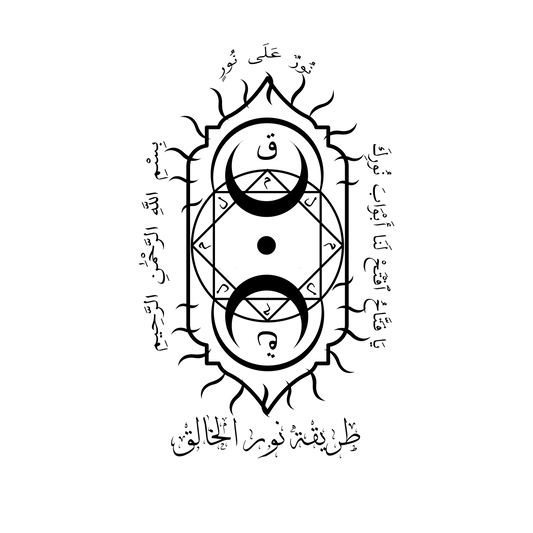
Madrasa an-Nur | Tariqa Nur al-KHaliq

Tariqa Nur al-Khaliq

Tariqa Nur al-Khaliq (The Path of the Light of the Creator) is a contemporary Sufi path dedicated to the purification of the soul, the awakening of spiritual perception, and the disciplined pursuit of Divine proximity through structured practice, sacred knowledge, and ethical living. While rooted in the foundational sources of Islam; the Qur’an, the Sunnah, remembrance (dhikr), prayer (ṣalāh), contemplation (murāqabah), and the broader tradition of spiritual refinement (taṣawwuf), the path is not bound to any single historical Sufi lineage structure, nor does it require formal affiliation to a traditional order. It integrates applied esoteric sciences as a disciplined part of its methodology, including the symbolic sciences of the Arabic letters (ʿIlm al-Ḥurūf), sacred geometry, the Divine Names (Asmāʾ al-Ḥusnā), numerical symbolism, esoteric cosmology, dream work, and the study of subtle perception through the signs (āyāt) within creation.

The framework also incorporates the authored works and applied methodologies of Jon Vermilion, forming part of a contemporary articulation of metaphysical practice within an Islamic spiritual foundation through the Islamic Grimoire Tradition and ruhaniya. Unlike traditional Sufi orders that are structured strictly around lineage-based transmission or external institutional affiliation, Tariqa Nur al-Khaliq emphasizes direct practice, ethical discipline, and experiential realization through structured inner training and applied spiritual work through proper esoteric training.

The path of the light of the creator

Entry into Tariqa Nur al-Khaliq

Entry into Ṭarīqa Nur al-Khaliq begins with open access to foundational information, including teachings, writings, and general guidance shared publicly through the platform. The path of bayʿah (commitment/pledge of sincerity to the path) is also open and not restricted by payment. This establishes a point of intention, reflection, and personal alignment with the principles of the Tariqa.

However, it is important to distinguish between open access to information and formal participation in the structured training system. The paid membership represents enrollment in an organized educational framework called a Madrasa (school).

The School of Light

Madrasa An-Nur

Al -Madrasa An-Nur is a graded process where study, practice, progression, and accountability are guided through a defined curriculum of grades and pillars. This functions as a structured school of development rather than general content access.

Beginning with the foundations of adab, worship, remembrance of God, prayer and inner purification, students gradually advance into the traditional sciences of Islamic spirituality and metaphysics. The curriculum includes the study of the Divine Names of Allah (al-Asmāʾ al-Ḥusnā), ʿIlm al-Ḥurūf (the Science of Letters), al-Awfāq (magic squares), Qur'anic symbolism, sacred cosmology, contemplative practices, and the intellectual heritage of Islamic mysticism. These sciences are presented within a disciplined framework that emphasizes ethics, humility, and spiritual responsibility.

Each Grade takes about 1+ year of study and application. (some may advance faster)

Service to Tariq (STT)

Khidmah Path Scholarship (KPS)

Alongside this exists the Khidmah Path Scholarship, which provides access to the same structured training system through service-based contribution (STT) rather than financial payment. Both pathways operate within the same curriculum and standards, with the difference being the mode of entry and participation.

In this way, the Tariqa maintains three layers of engagement: open teachings for general access, formal bayʿah as a declaration of intention, and structured membership (through payment or Khidmah) as the entry into disciplined training and progression.

*Application is Available at the bottom of the Page in the "Petition for Khidmah Path Scholarship"

Public Alignment

$0

Self-directed alignment with publicly shared teachings and principles. No formal enrollment or structured guidance.

Structured Guidance Access

$33 / month

Continuous enrollment into the guided training system. Includes structured progression through Grade 1 with ongoing instruction, practice, and evaluation.

Annual Structured Access

$333 / year

Same structured guidance access with reduced long-term commitment. Progression continues within the same system without re-purchasing grade levels.

Khidmah Path Scholarship

Service-Based

Full structured access granted through service contribution rather than financial payment. Khidmah (service) means active contribution of time, skill, or labor that supports the functioning and maintenance of the Tariqa system in exchange for full participation.

Your Membership Includes

  • Full access to the structured Grade 1 curriculum and continuous grades (based on individual progress)
  • Continuous guidance through lessons, practices, and spiritual exercises.
  • Graded "college" like structure of Esoteric Advancement through islamic metaphysics.
  • Video, PDF, and interactive lessons released according to the training schedule.
  • Access to the private member community.
  • Monthly articles and teachings on Islamic spirituality, Sufism, Arabic mysticism, and the traditional esoteric sciences.
  • Exclusive practical exercises, dhikr, contemplations, and study materials.
  • Ability to move at your own pace through a structured process
  • Monthly Live Sessions (one Sunday each month)
    - Up to 3 hours
    - Live teaching
    - Open Questions & Answers
    - Private member discussion
    - Recordings available if you cannot attend live.

Download Grade 1 Expectations to preview basic requirements of Grade 1.

Download Grade 1 Expectations
1 of 6

Petition for Khidmah Path Scholarship

The Khidmah Path Scholarship exists to ensure that sincere commitment to the path is never determined solely by financial circumstances.

Within the Madrasa an-Nur of Tariqa Nur al-Khaliq, we recognize that every student possesses something of value to offer. For some, that offering is financial support through membership. For others, it is Khidmah; selfless service performed with sincerity, excellence, and adab.

The scholarship is not a discount, nor is it financial aid in the conventional sense. It is an alternative form of contribution in which a student's service to the Ṭarīqa fulfills the spirit of membership. This reflects the long-standing Islamic understanding that serving knowledge and serving a community are themselves acts of worship when performed for the sake of Allah.

Students accepted into the Khidmah Path Scholarship receive the same structured curriculum, access to teachings, progression through the grades of Al-Madrasa An-Nur, participation in the private community, and monthly live sessions as other members. The expectation, however, is that this access is honored through consistent and meaningful service.

Examples of khidmah may include:
* Assisting with administrative tasks.
* Editing or proofreading educational materials.
* Graphic design or media creation.
* Website development or technical support.
* Video, audio, or content production.
* Translation or transcription work.
* Community moderation and member support.
* Research assistance.
* Other skills that contribute to the mission of
Tariqa Nur al-Khaliq.

The specific responsibilities of each scholarship student are determined according to the needs of the organization and the individual's abilities, experience, and available time. Scholarship placements are not one-size-fits-all; they are designed to create a meaningful exchange that benefits both the student and the community.

Acceptance into the Khidmah Path Scholarship is by application and approval only. Because the number of service opportunities is limited, not every applicant can be accepted. Applicants should be prepared to describe the skills they can offer, their availability, and their desire to contribute to the work of the Ṭarīqa.

The scholarship is founded upon accountability. Students are expected to complete their agreed-upon service with reliability, maintain the standards of adab expected within the community, and remain engaged with their studies. Failure to fulfill these responsibilities may result in the scholarship being suspended or discontinued.

The Khidmah Path Scholarship reflects a simple principle: every sincere seeker should have a path forward. Whether one contributes through financial support or through dedicated service, each plays a role in preserving, developing, and transmitting the sacred knowledge entrusted to Tariqa Nur al-Khaliq.

1. Personal Introduction
2. Spiritual Background
3. Experience in Esoteric Studies (years + details)
4. Areas of Study
5. Language Studies
6. Previous Teachers or Orders
7. Current Spiritual Practice and Beliefs
8. Intentions
9. Personal Strengths & Challenges
10. Commitment & Understanding of the Path
11. Books Studied
12. Understanding of Commitment
13. Final Statement

Madrasa an-Nur | Tariqa Nur al-Khaliq

Additional Information

Frequently asked Questions

1. Who can apply to join Ṭarīqa Nūr al-Khāliq?

Ṭarīqa Nūr al-Khāliq welcomes sincere seekers who are committed to spiritual growth, disciplined study, and the cultivation of adab (spiritual etiquette). No prior experience in Sufism or the esoteric sciences is required; only a genuine desire to learn and a willingness to engage respectfully with the curriculum.

2. Does submitting an application for Khidmah guarantee acceptance?

No. Every application is carefully reviewed. Admission is based on sincerity, suitability for the program, and alignment with the values of Ṭarīqa Nūr al-Khāliq. Enrollment fees or subscriptions do not guarantee acceptance into the Tariqa or Madrasa.

3. What will I study as a student?

Students begin with the foundations of spiritual practice, including adab, ṣalāh, dhikr, meditation, and purification of the self (through the 28 lights and Prayer). As they progress through the grades, they are gradually introduced to the deeper Islamic esoteric sciences, including the Divine Names (Asmāʾ al-Ḥusnā), ʿIlm al-Ḥurūf (Science of Letters), Awfāq, dream work, contemplative disciplines, and other advanced teachings appropriate to their level. Please see the 7 Pillars Document.

4. How does progression through the Madrasa work?

The curriculum is structured into progressive grades. Students advance by completing lessons, demonstrating understanding, and embodying the principles taught; not just by the passage of time. Each stage builds upon the previous one, ensuring a balanced and disciplined spiritual development.

5. Can my membership be revoked?

Yes. Membership in Ṭarīqa Nūr al-Khāliq is founded upon adab, integrity, and mutual respect. The Tariqa reserves the right to suspend or revoke membership if a student consistently acts in a manner that is harmful to the community, violates its ethical standards, or refuses to uphold the responsibilities expected of a member. The preservation of a sincere and respectful learning environment is of the highest importance.

6. Is this an online or in-person Tariqa?

Ṭarīqa Nūr al-Khāliq is currently offered as an online school of spiritual study, allowing students from around the world to participate. Lessons, guided practices, live teachings, and community discussions are provided through the Madrasa, enabling students to progress at their own pace while remaining connected to the Tariqa. Through the Mureed Portal each Mureed (student) will have access to ask the Sheik directly about the lessons and receive feedback directly. Monthly live videos are major discussions and teaching on the grades material. If you are in Grade 1, the material covered is based on that grade. If you are Grade 2, the discussions are based on Grade 2, etc.

7. How much time should I dedicate each week?

Ṭarīqa Nūr al-Khāliq is designed as a path of steady and deliberate spiritual formation rather than rapid completion. While students are encouraged to maintain a consistent daily practice of ṣalāh, dhikr, contemplation, and study, each grade is projected to take approximately one year to complete for those seeking a full understanding and integration of its teachings and system. Progress is measured not only by completing lessons, but by embodying the principles and practices of each stage before advancing to the next.

8. What makes Ṭarīqa Nūr al-Khāliq different from other spiritual schools?

Ṭarīqa Nūr al-Khāliq combines traditional Sufi principles of adab, dhikr, and inner purification with a structured, grade-based curriculum that systematically introduces students to the Islamic esoteric sciences. Rather than presenting these disciplines as isolated teachings, the Tariqa integrates them into a progressive path of spiritual formation, emphasizing ethical responsibility, experiential understanding, and the harmonious development of both the outward and inward dimensions of the seeker.

Materials Needed

To ensure every student is properly equipped for both written and practical work throughout the curriculum of Tariqa Nur al-Khaliq, each student is expected to obtain the following materials before beginning their studies.

(Grade 1 Materials are Bold)

Writing & Study Materials

  • Blank (unlined) notebooks
  • Lined notebooks
  • Squared (graph/grid) notebooks
  • Mechanical pencils
  • Pencil lead refills:0.3 mm0.5 mm0.7 mm
  • A selection of Colored pens
  • A selection of Colored pencils
  • Erasers (fine and wide tipped, Tombow Brand recommended)
  • Pencil sharpener (for Colored pencils)
  • Highlighters (recommended)

Mathematical & Geometric Instruments

  • Mathematical compass (adjustable)
  • Protractor
  • 30°/60° set square
  • 45° set square
  • 30 cm (12") ruler
  • 15 cm (6") Ruler
  • Flexible ruler (recommended)
  • Circle template (recommended)

General Study Supplies

  • Binder or expanding folder for printed course materials
  • Sticky notes or page markers
  • Index cards (recommended)
  • Blank Tarot Cards (recommended)
  • Blank Wooden Dice (7 of them)
  • Fine-tip black marker (.3 / .5)

Digital Requirements

  • A reliable computer or tablet
  • Stable internet connection
  • PDF reader
  • Ability to view online course videos
  • Ability to print course worksheets and diagrams when required

Note: This is a comprehensive list of what could be needed. Throughout the higher grades of the curriculum, additional specialized materials; such as those used in geometry, letter sciences (ʿIlm al-Ḥurūf), Awfāq, meditation practices, and other practical exercises will be introduced as needed. Students will receive advance notice before any additional materials are required.

Required Texts

The following texts form part of the core supporting curriculum of Tariqa Nur al-khaliq and are considered required reading for students enrolled in the Madrasa. These works provide additional theological, spiritual, philosophical, historical, and practical foundations that complement the lessons being taught throughout the program.

Students are expected to obtain copies of each text and study them alongside the official written works, manuals, and instructional materials provided by Tariqa Nur al-khaliq. These readings are intended to support and deepen the student’s understanding, and do not replace the teachings, writings, or structured curriculum of Tariqa Nur al-khaliq itself.

Some books may be assigned in their entirety, while others may only require selected chapters or passages. Reading assignments will be provided throughout the duration of the program according to the student’s grade and stage of study.

Required Texts

  • Tajweed Qur'an (Whole Quran, With Meaning Translation and Transliteration in English) (Arabic and English) | Dar Al-Ma'arifah
  • The Arabic Alphabet (how to read and write) | Nicholas Awde & Puros Samano
  • In The Master's Way: Memorable Moments With A Grand Master Of Sufism | Monica Canducci
  • Suns of Lights and the Great Treasures of Secrets: A Translation of Shams al-Anwar wa Kunuz al-Asrar al-Kubra | Ibn al-Hajj al-Tilmsani al-Maghribi
  • Shams al-Ma'arif al-Kubra: The Complete Sun of Divine Knowledge | Aḥmad al-Būnī
  • Asaya ka Luxa | Jon Vermilion
  • Esoteric Prayer | Jon Vermilion
  • Besels of wisdom | Ibn arabi
  • Fourty principles of the religion | Imam ghazali
  • Divine Sayings: 101 Hadith Qudsi: The Mishkat al-Anwar of Ibn 'Arabi


Note: Additional recommended and supplementary reading may be assigned throughout the course as students advance into the higher grades of the curriculum. These works are intended to broaden scholarship, encourage deeper reflection, and provide further context for the sciences being studied, while remaining secondary to the primary teachings and written curriculum of Tariqa Nur al-khaliq. Some lessons will require reading a selected text and reporting on it in reflection of the Tariqa.